Starting a jewelry business means choosing more than a product line — it means choosing an entire cost structure, customer base, and growth path. For small retailers weighing their options, the silver vs gold jewelry comparison usually comes down to one question: where can you make real money without tying up capital you don't have?
This guide breaks down startup costs, margins, demand, and long-term scalability so you can decide which metal fits your business, your budget, and your customers.
Gold and silver jewelry sit at opposite ends of the retail spectrum, and the differences go well beyond color.
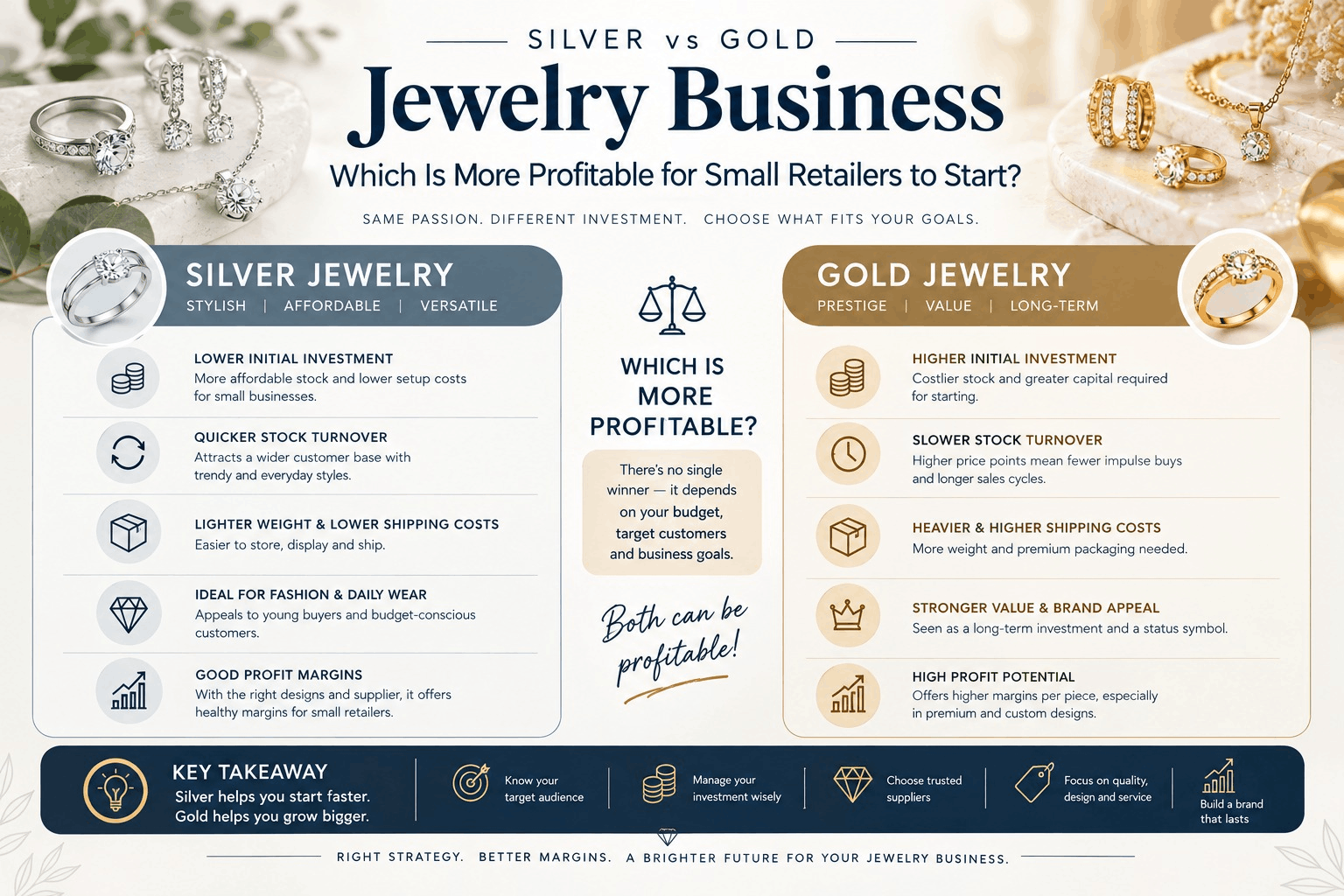
Gold is priced almost entirely by weight and purity. Its market value is high, well-known to customers, and closely tracked against global gold rates — which means pricing is transparent, but margins are thin unless you're selling at real volume. Silver, by contrast, has a much lower raw material cost, giving retailers far more room to price around design, craftsmanship, and branding rather than the metal itself.
The other major difference is inventory risk. A gold display case worth the same money as a silver one holds a fraction of the pieces, which limits variety and ties up cash in fewer SKUs. Silver lets a small retailer stock a wider, more fashion-forward range for the same investment — a meaningful factor in any silver vs gold jewelry comparison for a business just getting started.
For small and independent retailers, yes — in most cases. Whether a silver jewelry Business is more profitable than gold comes down to markup flexibility. Gold's high raw cost forces retailers to keep markups modest, since customers are price-sensitive to a metal they can check against live market rates. Silver's low base cost means even a moderate percentage markup translates into a healthy dollar margin, and design-led silver pieces (stackable rings, layered pendants, statement earrings) routinely carry markups gold simply can't sustain without pricing out the average buyer.
Gold can still be profitable, but it typically favors larger operations that can move volume, offer financing, or specialize in bridal and investment pieces. For a retailer starting small, silver's economics are simply more forgiving.
Startup capital is often the deciding factor in silver vs gold jewelry for small business planning. A gold inventory that looks respectably stocked can easily require several times the investment of an equally full silver display, since the metal cost dominates the price of every single piece.
Gold demands more caution at the outset — bigger loans or savings, tighter insurance requirements, and a longer runway before the business turns a profit. Silver, on the other hand, gets a small retailer to market faster and with less risk on the table.
When it comes to which jewelry business has better profit margins, silver again tends to win for smaller operations, mainly because so much less of the retail price is locked into raw material cost. That leaves more room for the retailer's own margin — on design, branding, and craftsmanship — rather than simply passing through the metal price with a thin markup on top.
Gold margins compress further whenever gold prices spike, since customers become more price-conscious and retailers have less flexibility to hold their markup. Silver's lower price point makes it less sensitive to these swings, giving small retailers steadier, more predictable margins month to month — a real advantage when answering which jewelry business has better profit margins for a business without deep cash reserves.
Demand patterns differ sharply between the two metals, and understanding who's buying each one matters as much as the numbers behind them.
Gold buyers tend to be purchasing for milestone occasions — weddings, anniversaries, and gifting tied to cultural or religious tradition. Many treat gold as a store of value as much as an adornment, which means purchase decisions are slower, more considered, and often influenced by daily gold rates. This customer base is loyal but smaller in volume, and purchases are typically less frequent.
Silver buyers skew toward everyday, fashion-driven purchases. This includes younger shoppers, gift buyers, and customers building a rotating jewelry collection rather than a single significant piece. Because silver pieces are more affordable, customers buy more often and are more willing to experiment with new styles — a pattern that rewards retailers who refresh their catalog regularly and lean into current design trends.
Silver is generally the easier entry point. Lower capital requirements, simpler sourcing, and a broader base of potential customers all reduce the barriers a new retailer has to clear. Gold businesses often need established supplier relationships, higher security standards, and enough working capital to weather slower-turning, higher-value inventory — all of which are harder to arrange from a standing start. That doesn't rule gold out entirely. A retailer entering a market with strong existing demand for gold — a bridal-focused boutique, for instance, or a region where gold carries strong cultural weight — may still find it worthwhile. But for most small retailers testing the waters, silver offers a lower-risk way in.
Many successful retailers don't choose exclusively — they start with silver to build cash flow and customer trust, then introduce gold pieces once the business has the capital and reputation to support it.
Small, consistent improvements in sourcing and merchandising tend to move the needle more than any single big decision.
For most small retailers, silver offers the more accessible and forgiving path to profitability, with lower startup costs and steadier margins than gold, which tends to reward retailers who already have capital or established demand — and whichever direction you choose, partnering with an experienced silver jewelry wholesale manufacturer like Glorietta Jewels makes it easier to turn that choice into a profitable one.
Don’t Miss Out – Start Browsing Our Wholesale Silver Catalogue Now
VIEW CATALOGUEBuy Direct from the Manufacturer – 925 Sterling Silver at the Best Quality and Price.
CONTACT US