A stamp reading 925 looks simple, but what stands behind it changes from one market to the next. In the UK, an assay office applies the mark. In the US, the maker stamps it and takes legal responsibility for it. Other countries fall somewhere in between. Understanding silver hallmarking by country helps buyers read a piece correctly and helps wholesalers ship jewelry that clears the importing market without delays.
Glorietta Jewels is a Thailand-based sterling silver jewelry manufacturer supplying B2B wholesale export. We work to the marking requirements of each destination market. This guide covers what 925 means, how major markets mark and regulate it, and how purity gets checked.
Sterling silver is an alloy of 92.5% pure silver and 7.5% other metals, usually copper. Pure silver is too soft for everyday jewelry, and the added metal gives rings, chains, and clasps the strength to hold their shape. The number 925 on a piece is a claim about that composition.
For a retail buyer, the mark is the quickest way to tell sterling from plated or lower-grade metal. For a wholesaler, it carries more weight. A mislabelled lot can mean a customs hold, a rejected shipment, or a trading standards complaint in the destination country. Silver purity verification protects both sides: the buyer receives the metal they paid for, and the supplier has a record to back up the stamp.
Most national systems follow one of three approaches. Some require an independent assay office to test and mark every qualifying item. Others rely on the maker’s own stamp, backed by legal liability. A few treat marking as voluntary, though trade practice usually makes it standard. Despite these differences, nearly all systems are built around the same fineness numbers, such as 800, 925, 958, and 999, which is why international silver standards are easier to work with than the legal differences might suggest.
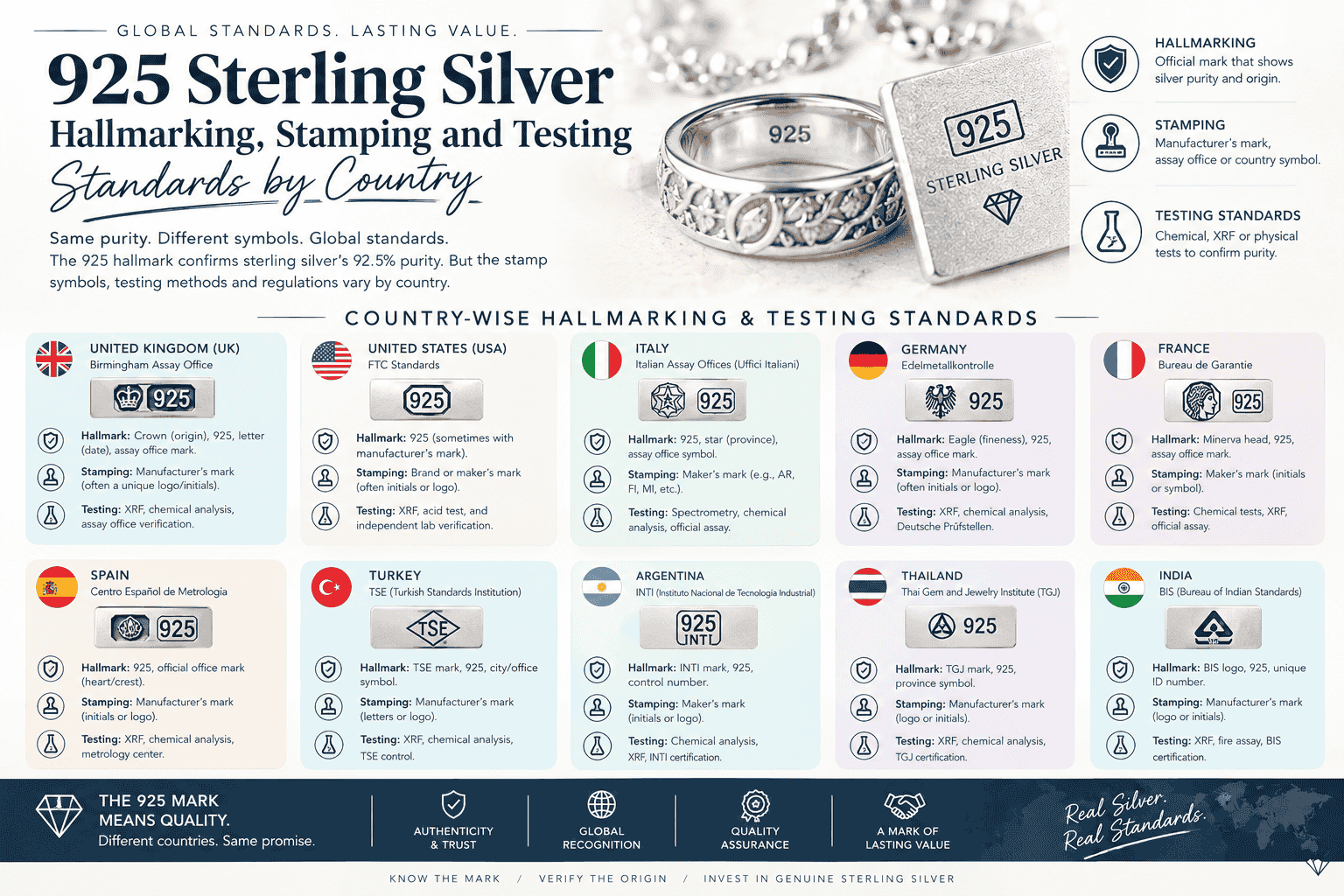
The UK has one of the strictest systems. Under the Hallmarking Act 1973, silver articles above 7.78 grams must be tested and hallmarked by a UK assay office before they can be sold as silver. The four assay offices are London, Birmingham, Sheffield, and Edinburgh, each with its own town mark.
A standard sterling hallmark has three compulsory parts:
A date letter and the traditional lion passant symbol are optional. Items under the weight threshold are exempt, though many makers mark them voluntarily. Imported jewelry must also be submitted to an assay office before sale, which is why exporters need to plan for it in the UK trade.
The US has no government assay system. Marking is governed by the National Stamping Act and the FTC Jewelry Guides. Under those rules, a piece can only be called “sterling” or “sterling silver” if it contains at least 92.5% silver. Makers typically stamp “925” or “Sterling,” and quality marks are expected to be accompanied by the maker’s registered trademark.
Because no third party tests the metal before sale, responsibility sits with the manufacturer and seller. That makes consistent in-house quality control and clear documentation especially important for export suppliers.
Europe has no single hallmarking law. Each country sets its own, which is why compliance needs to be checked market by market. Italy requires a maker’s identification mark alongside the fineness stamp. France runs a state-controlled marking system. Germany leaves fineness marking voluntary, although a 925 stamp with a maker’s mark is the norm in the trade.
The main bridge across these systems is the Common Control Mark, issued under the International Convention on Hallmarking. An item carrying it, a pair of scales plus the fineness number, can be traded between member states without being retested.
Outside the UK, US, and Europe, the picture is similar. Many countries adopt the same fineness grades and enforce them through assay offices, customs inspections, or trade standards bodies. India, for example, operates a national hallmarking scheme through the Bureau of Indian Standards.
For manufacturers in Thailand, the working practice is to stamp 925 together with a maker’s mark, then follow the marking and testing rules of the country the goods are going to. Documentation such as test reports and batch records supports the stamp when an importer or authority asks for proof.
A mark is only as reliable as the check behind it. Each of the sterling silver testing methods below has a different level of accuracy and cost:
In practice, manufacturers use faster surface checks during production and rely on fire assay or lab reports where a formal result is needed.
A 925 stamp means the same thing everywhere, but the way it is applied and enforced does not. The UK requires an assay office hallmark, the US relies on the maker’s accountability, and Europe splits across national systems linked by the Common Control Mark. For anyone buying or selling sterling silver across borders, learning silver hallmarking by country is the first step to avoiding rejected shipments and disputes.
If you are sourcing sterling silver jewelry for wholesale and want pieces marked and documented for your market, get in touch with the Glorietta Jewels team to discuss your requirements.
Don’t Miss Out – Start Browsing Our Wholesale Silver Catalogue Now
VIEW CATALOGUEBuy Direct from the Manufacturer – 925 Sterling Silver at the Best Quality and Price.
CONTACT US