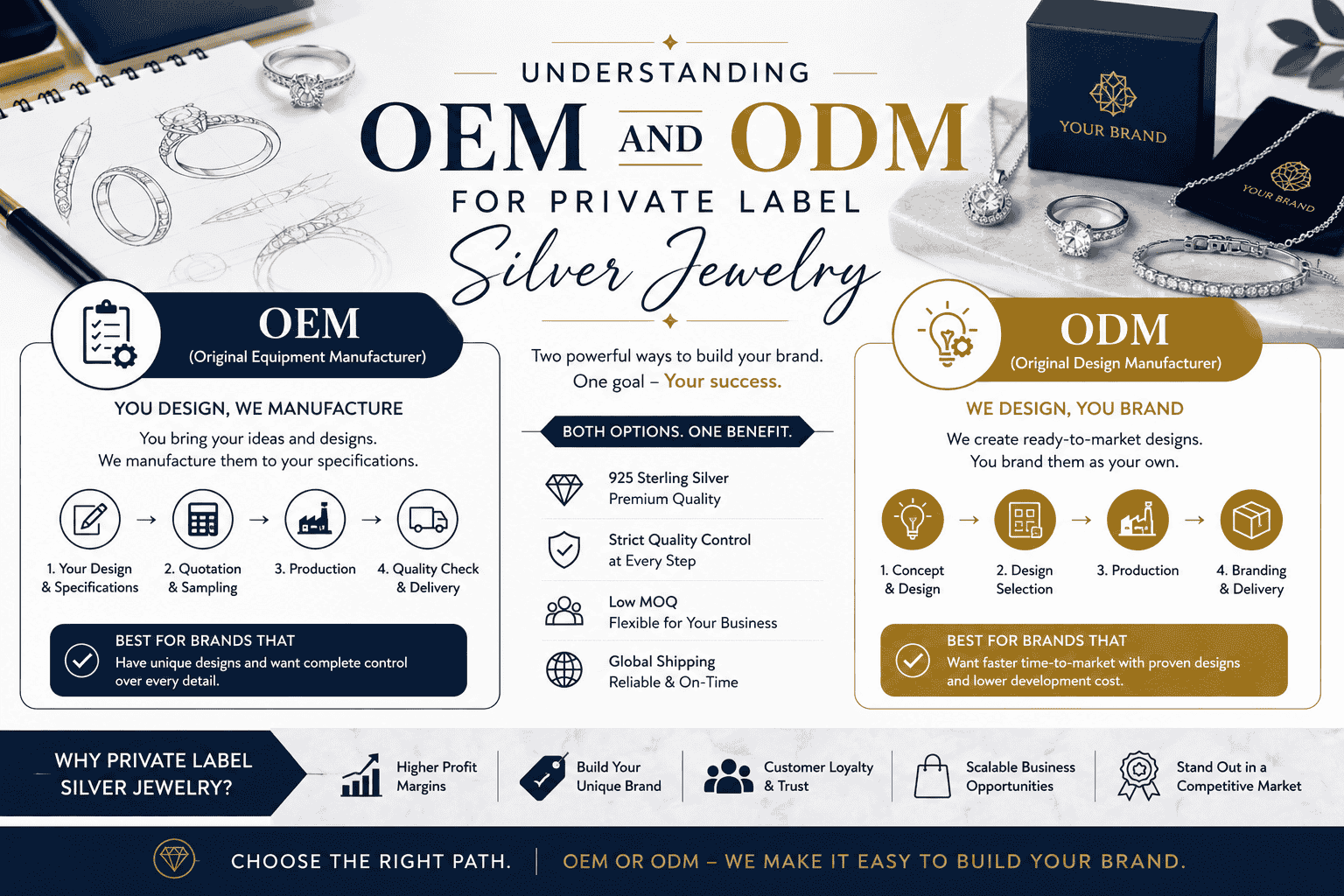
If you're building a private label jewelry brand, one of the first sourcing decisions you'll face is choosing a manufacturing model. Most suppliers offer either OEM or ODM production, and the two work very differently once you get past the acronyms. Retailers weighing OEM or ODM for private label often start with the same question: which is better OEM or ODM for a brand that wants full control over design, and which suits a brand that wants to move fast with proven styles? There's no single right answer — it depends on your design capacity, budget, and how quickly you need to get product to market. This guide breaks down both models so you can decide which fits your jewelry line.
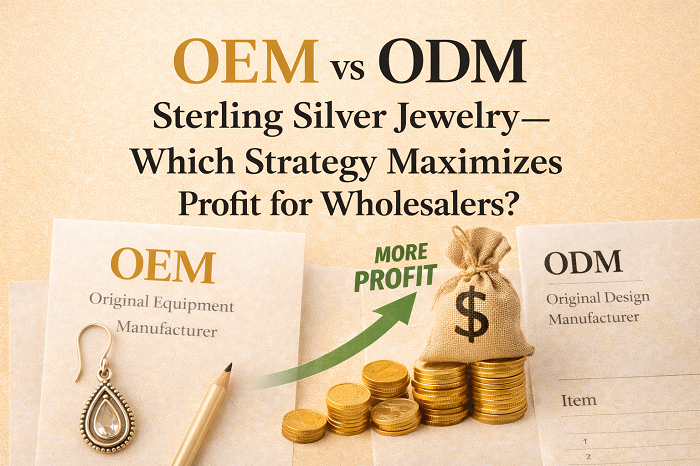
OEM (Original Equipment Manufacturer) means the manufacturer produces jewelry to your exact specifications. You bring the design, the technical drawings or CAD files, and the manufacturer handles casting, plating, and finishing according to your instructions. The intellectual property stays with you.
ODM (Original Design Manufacturer) flips this. The manufacturer already has a design library or in-house design team, and you select or adapt an existing style, then apply your branding — packaging, hallmark, tags. You're not creating the design from scratch; you're licensing or private-labeling something the manufacturer already developed.
The core difference comes down to who owns the design process. When people ask which is better OEM or ODM, they're usually really asking whether they want to design their own collection or start from a manufacturer's catalog. Both are legitimate paths for OEM or ODM private-label sourcing — the right choice depends on where your brand is in its growth.
Margins under each model depend on volume, design complexity, and how differentiated your product needs to be to compete. ODM does have lower upfront costs, since there's no tooling or design development fee — you're using existing molds and designs, so entry costs are lower for a brand just testing the market with limited capital.
OEM carries higher setup costs upfront — tooling, sample rounds, and design refinement all add time and expense before the first production run. Where OEM tends to pay off is in pricing power: because the design is exclusive to your brand, competitors can't undercut you with an identical piece sourced from the same catalog. Exclusive designs support premium positioning, repeat customers associate the style with your brand rather than the manufacturer, and the tooling cost is a one-time investment that can keep paying off across future reorders.
So on the question of which is more profitable, OEM or ODM — it depends on where your brand is. ODM keeps costs low while you're still testing demand, which is its own kind of capital efficiency. OEM asks for more upfront but is generally positioned as the model with stronger long-term margin potential, since shared designs cap how much pricing power and brand equity you can build on a catalog piece, while an exclusive design gives you room to grow into.
The decision comes down to budget, timeline, and how much you value exclusivity. ODM suits brands testing demand fast with limited capital. OEM suits brands ready to invest in a design that's theirs alone — and it's this ownership that opens the door to the stronger long-term margin potential covered above.
Many brands start with ODM to establish cash flow, then shift bestsellers into OEM once volume justifies tooling. When retailers ask which manufacturing model is best for jewelry brands, the honest answer is that it depends on stage: ODM is a practical way to launch and test, while OEM is the better fit once a brand is ready to build something distinct and defensible. As a brand grows, the answer to which is better OEM or ODM tends to shift toward OEM.
Glorietta Jewels works primarily with OEM production for sterling silver rings and pendants, supporting wholesale buyers who want their own designs manufactured to spec rather than selected from a stock catalog. This means brands retain ownership of their designs, work directly with the manufacturing team on technical specifications, and get pieces cast, set, and finished to their exact requirements — without the risk of the same design appearing on a competitor's shelf.
For B2B buyers building a private label silver jewelry line, this OEM-first approach is built around giving retailers the control and exclusivity that a distinct brand identity requires, backed by sterling silver manufacturing experience and export-ready production for international wholesale markets.
Don’t Miss Out – Start Browsing Our Wholesale Silver Catalogue Now
VIEW CATALOGUEBuy Direct from the Manufacturer – 925 Sterling Silver at the Best Quality and Price.
CONTACT US