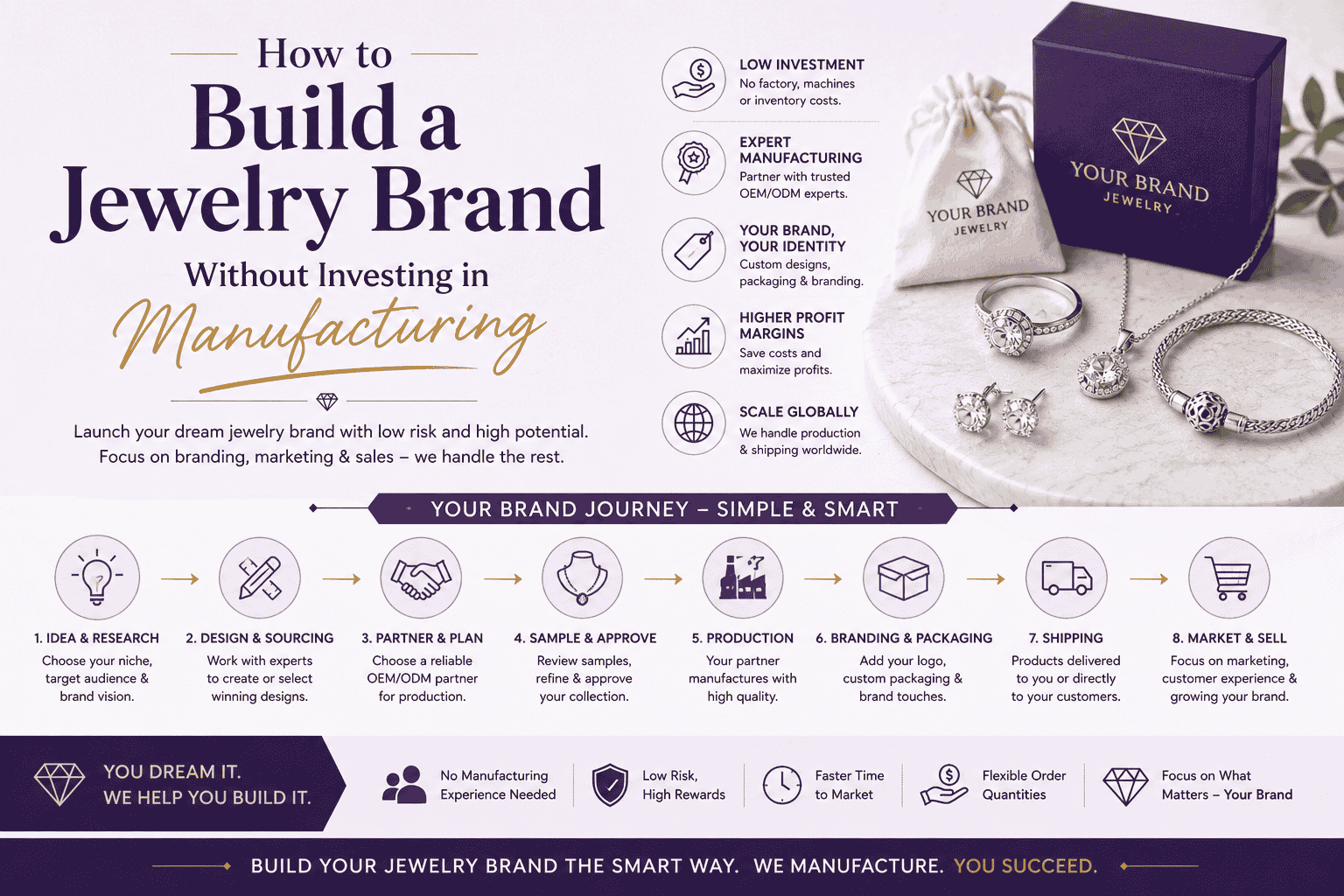
Starting a jewelry line used to mean renting workshop space, buying casting equipment, and hiring skilled artisans before you sold a single piece. That barrier has largely disappeared. Today, the fastest and most practical way to enter the market is to partner with an established manufacturer and put your energy into design, branding, and sales instead.
This guide walks through exactly how to launch a jewelry brand step by step, using a private label model built on 925 sterling silver — one of the most reliable materials for wholesale and retail jewelry businesses.
Manufacturing is capital-intensive, slow to scale, and unforgiving of mistakes. A single casting machine, polishing setup, and stone-setting station can cost more than most new brands raise in their first year — and that's before accounting for skilled labor, quality control, and the metal itself.
Sterling silver production specifically requires precise alloy ratios, controlled tarnish-resistant finishing, and hallmarking knowledge that takes years to develop in-house. Most founders don't need to own that process; they need consistent access to it. This is exactly why so many new labels choose to start a jewelry brand without manufacturing and instead work with a partner who already has the tooling, the workforce, and the quality systems in place.
Working with a dedicated manufacturer gives a new brand three things it can't easily build alone: production capacity, technical expertise, and price stability. A factory that already produces at scale can offer per-piece costs that would be impossible for a small operation to match, simply because the fixed costs of casting, polishing, and plating are spread across a much larger volume.
There's also a speed advantage. An established sterling silver manufacturer can typically turn around a sample or a small production run in days, not months, because the equipment and skilled hands are already in place. That responsiveness matters most in the early stages, when a brand is still testing what sells. Manufacturers like Glorietta Jewels, a Thailand-based 925 sterling silver manufacturer built specifically for B2B wholesale export, are set up to support exactly this stage — ready-made collections, private labeling, and export experience in one place.
Before contacting any supplier, get specific about what the brand actually is. Vague positioning ("nice, affordable jewelry") makes every downstream decision harder — sourcing, pricing, even packaging.
Useful questions to answer first:
A clear answer to these questions is really the first move in how to create a jewelry brand that has a coherent identity instead of a random product catalog.
Not every supplier is a fit. A manufacturer that mainly produces costume jewelry won't have the hallmarking or alloy consistency needed for genuine 925 silver. Look for a few concrete signals before committing:
This is where the actual lessons of starting up a jewelry line are learned since the manufacturer will define everything else: the cost, lead times, and the product quality. Glorietta Jewels meets all the criteria needed by the jewelry brands that source genuine 925 sterling silver in wholesale quantities, producing the products themselves and exporting the goods internationally.
New brands don't have to design from a blank page. Most manufacturers maintain catalogs of ready-made designs — rings, pendants, earrings, chains — that can be sold as-is or lightly customized. This is a practical way to get a store or wholesale line live within weeks rather than waiting on a full custom design cycle.
Starting with ready-made pieces also gives a founder real market feedback early. Selling proven designs first, then investing in custom pieces once demand is validated, lowers the financial risk of guessing wrong on a first collection.
Private labeling is what turns a supplier's product into your product. This typically includes custom stamping or engraving on the piece itself, branded packaging, hang tags, and care cards — all produced or coordinated by the manufacturer under your name.
For anyone researching how to launch a private label jewelry brand, this step is the core of the model: the manufacturing stays with the factory, while the brand identity — name, story, packaging, positioning — stays entirely with you. Customers see your brand; they never need to know who cast the piece. Glorietta Jewels offers private labeling on its sterling silver rings and pendants for exactly this reason, so wholesale partners can put their own name on proven, export-ready pieces.
Skipping samples is one of the most expensive mistakes a new brand can make. Photos and spec sheets don't show how a finish actually looks under light, how a clasp feels in hand, or how consistent the plating is across pieces.
Order samples of every design under consideration, check them against the promised specifications, and only then commit to a production run. A manufacturer that resists providing samples, or charges unreasonably for them, is worth reconsidering as a long-term partner.
Don’t Miss Out – Start Browsing Our Wholesale Silver Catalogue Now
VIEW CATALOGUEOverordering ties up cash in stock that may not sell; underordering means running out during the exact moment demand picks up. A workable approach is to start with a manufacturer's minimum order quantity across a tight, curated set of designs rather than spreading a small budget thin across dozens of styles.
Track which pieces move fastest, then reorder based on that data rather than guesswork. Manufacturers who are used to working with growing brands will usually support smaller repeat orders as sales patterns become clearer.
With production outsourced to a trustworthy partner, the real work of the founder begins, and it includes marketing, merchandising, building customer relationships and developing new sales channels. This is the practical payoff of the whole model: time and capital go toward growth instead of operations.
This is ultimately what separates founders who understand how to launch a jewelry brand that scales from those who get stuck managing day-to-day production headaches instead of building demand.
Taken together, these advantages are why so many founders now start a jewelry brand without manufacturing of their own and still compete effectively against labels that do.
The right manufacturer should be able to support a brand at every stage — small trial orders in year one, larger and more complex runs as demand grows. Before signing on with anyone, ask about their capacity ceiling, how they handle design revisions, what their communication process looks like across time zones, and whether they've worked with export markets similar to yours.
A manufacturer that treats a new brand as a long-term account, not just a one-off order, tends to offer better pricing flexibility and faster problem-solving when something needs adjusting mid-production.
None of this requires owning a factory. With the right sterling silver manufacturing partner, a founder can source proven designs, apply private labeling, order sensibly, and put full attention into building the brand customers actually see. For anyone still weighing how to create a jewelry brand from scratch, the private label route remains the most direct way to get from idea to shelf-ready product without the overhead of production.
Glorietta Jewels supports wholesale and private label brands with custom 925 sterling silver collections, sample-first ordering, and export experience across international markets. If you're ready to move from planning to sourcing, get in touch with Glorietta Jewels to talk through your first collection.
Buy Direct from the Manufacturer – 925 Sterling Silver at the Best Quality and Price.
CONTACT US